01 · CHECK ELIGIBILITY
All of these conditions must fit your trip
- Eligible nationalityYou are a citizen of one of the 57 countries listed below and travel on an ordinary passport.
- Valid passportNational Immigration Administration application guidance requires a valid international travel document with at least three months’ validity.
- True transit routeYou enter China from one country or region and continue to a different third country or region. A direct return to your point of origin is not a qualifying transit route.
- Confirmed onward travelYou hold a ticket or other proof showing a confirmed departure date and itinerary within 240 hours, and you meet the entry conditions for your next destination.
- Port approvalYou complete the temporary-entry procedure and pass immigration inspection at an eligible port. Eligibility does not guarantee admission.
A route such as Country A → Chengdu → Country B can fit the policy. Country A → Chengdu → Country A does not meet the official requirement to continue to a third country or region.
02 · 57 ELIGIBLE COUNTRIES
Check the nationality on your ordinary passport
Albania, Austria, Belarus, Belgium, Bosnia and Herzegovina, Bulgaria, Croatia, Cyprus, Czech Republic, Denmark, Estonia, Finland, France, Germany, Greece, Hungary, Iceland, Ireland, Italy, Latvia, Lithuania, Luxembourg, Malta, Monaco, Montenegro, the Netherlands, North Macedonia, Norway, Poland, Portugal, Romania, Russia, Serbia, Slovakia, Slovenia, Spain, Sweden, Switzerland, Ukraine and the United Kingdom.
Argentina, Brazil, Canada, Chile, Mexico and the United States.
Australia and New Zealand.
Brunei, Indonesia, Japan, Kyrgyzstan, Qatar, Singapore, South Korea, the United Arab Emirates and Vietnam.
Vietnam and Kyrgyzstan were added on August 20, 2026. Older official pages and third-party guides may still show 55 countries; use the National Immigration Administration’s current 57-country list.
03 · TIME LIMIT
The maximum stay is 240 hours
The National Immigration Administration describes the policy as a stay of no more than 10 days. Its application guidance states that the visa-free period begins at 00:00 on the day after entry. Your onward departure must fall within the permitted period, and the date or conditions issued by immigration officers at the port control your stay.
Keep the onward booking, passport and destination-entry documents available throughout the trip. If disruption threatens your authorized departure, contact immigration authorities rather than assuming the period extends automatically.
04 · WHERE YOU MAY TRAVEL
The Sichuan travel area covers 11 cities, not the whole province
The permitted area is Chengdu, Zigong, Luzhou, Deyang, Suining, Neijiang, Leshan, Yibin, Ya’an, Meishan and Ziyang. Stay within the areas authorized under the policy and use eligible ports for departure.
 11permitted city-level areas
- 1Chengdu
- 2Deyang
- 3Suining
- 4Ziyang
- 5Meishan
- 6Ya’an
- 7Leshan
- 8Neijiang
- 9Zigong
- 10Yibin
- 11Luzhou
Central Chengdu, the Leshan Giant Buddha area, Meishan, Yibin and the other named city-level areas.
The official list does not include Aba Tibetan and Qiang Autonomous Prefecture, Garzê Tibetan Autonomous Prefecture or Liangshan Yi Autonomous Prefecture. Jiuzhaigou and Huanglong are therefore outside the permitted area. Ya’an is an important exception: it is one of the 11 listed city-level areas.
The national policy permits cross-regional travel within designated areas. Confirm a multi-province route and its exit port with the National Immigration Administration’s 12367 service before booking, especially when the route leaves the 11-city Sichuan area.
05 · CHENGDU ENTRY PORTS
Both Chengdu airports are eligible ports
You may apply at Chengdu Tianfu International Airport (成都天府国际机场, TFU) or Chengdu Shuangliu International Airport (成都双流国际机场, CTU). Check the airport code on every flight segment: TFU and CTU are separate airports.
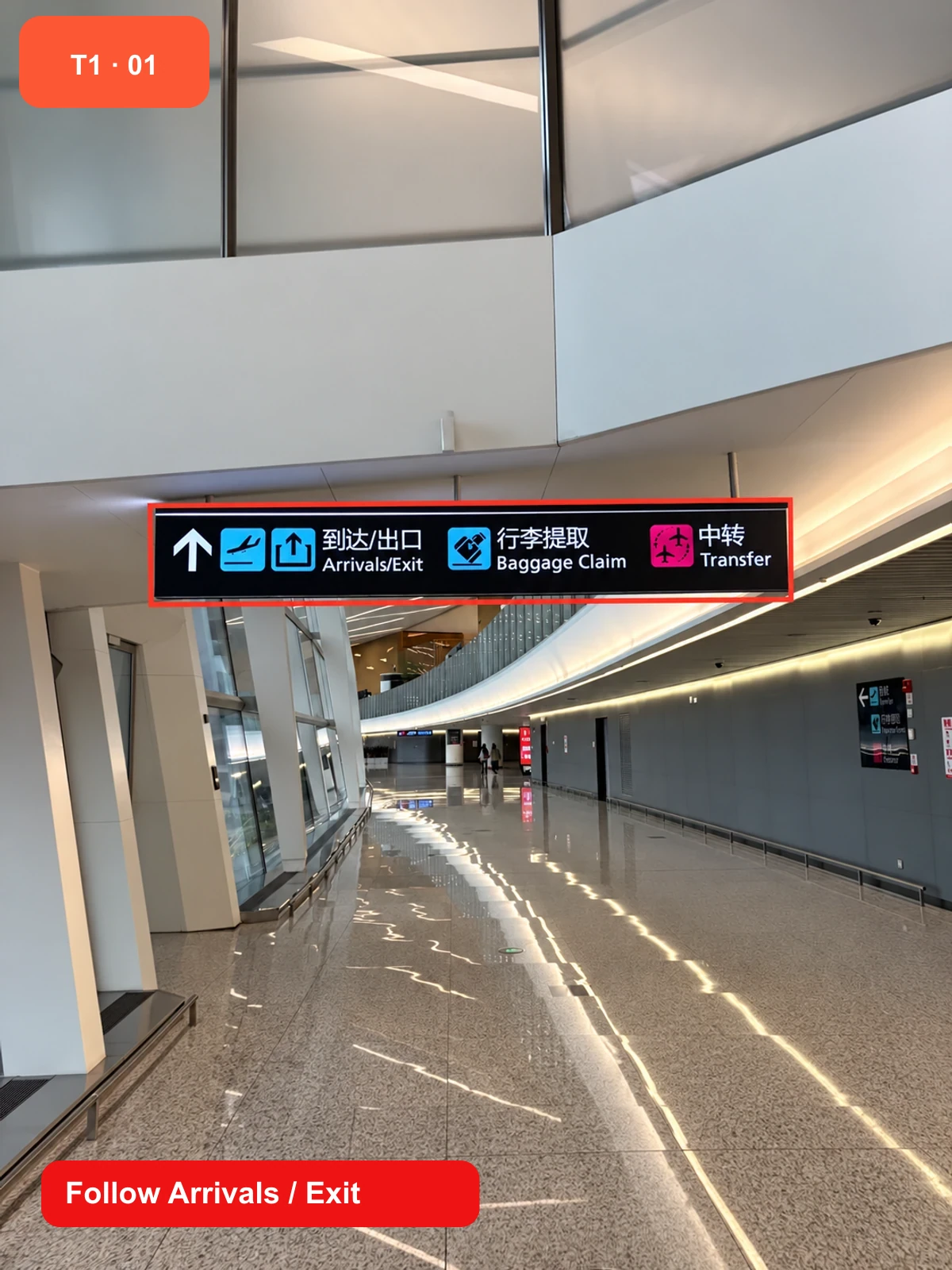

For transport from the terminal, use our separate Tianfu Airport (TFU) arrival guide or Shuangliu Airport (CTU) arrival guide.
06 · AIRPORT APPLICATION
Prepare the documents before you reach immigration
Confirm the route before departure
Check that your passport nationality is eligible, that China is between two different countries or regions, and that your onward journey leaves within the permitted period.
Keep proof of onward travel ready
Carry your ordinary passport, confirmed onward ticket or itinerary, and evidence that you may enter the next country or region. The official conditions require a confirmed departure date and itinerary.
Complete the arrival information
Fill in the temporary-entry arrival information as directed. China’s National Immigration Administration provides online arrival-card channels, while travelers who cannot use them may complete the process at the port.
Apply to immigration at TFU or CTU
Tell the border-inspection officer that you are requesting 240-hour visa-free transit. Present the documents and answer questions about your route, accommodation and departure. The officer decides whether to issue temporary entry.
Check the authorized stay
Before leaving the inspection area, read the permitted dates and conditions on your entry record. Stay within the approved area and depart through an eligible port before the authorized period ends.
07 · DO NOT MIX UP THE RULES
Three different entry situations
| Situation | Who it covers | Core limit | What it means |
|---|---|---|---|
| 240-hour visa-free transit | Ordinary-passport citizens of 57 listed countries who continue to a third country or region | Up to 240 hours in designated areas after port approval | The policy covered by this guide. |
| 24-hour visa-free transit | Travelers of all nationalities at open ports, with valid travel documents and confirmed onward tickets | No more than 24 hours, normally within the restricted port area | Leaving the restricted area requires a temporary entry permit. |
| Ordinary visa or another visa-free policy | Depends on nationality, passport, purpose and the separate policy | Depends on the visa or exemption | Use the rules for that visa or exemption; it is not granted by the 240-hour transit policy. |
08 · FAQ
Questions that change whether the trip qualifies
Is 240-hour visa-free transit the same as visa-free entry or a tourist visa?
No. It is a transit policy for eligible travelers continuing from China to a third country or region. Ordinary visas, bilateral visa waivers and China’s other visa-free entry policies have separate eligibility, purposes and stay limits.
Does a round trip such as Tokyo–Chengdu–Tokyo qualify?
No. The policy requires onward travel to a third country or region. Returning directly to the country or region from which you entered China does not meet that transit pattern.
Do separate tickets qualify?
The official condition is a confirmed onward ticket or other proof showing the departure date and itinerary within 240 hours. It does not say that all segments must be on one booking. The port officer still reviews the complete itinerary, so keep every booking and destination-entry document ready.
Can I visit anywhere in Sichuan?
No. The permitted Sichuan area is limited to Chengdu, Zigong, Luzhou, Deyang, Suining, Neijiang, Leshan, Yibin, Ya’an, Meishan and Ziyang.
Can I visit Jiuzhaigou or Huanglong?
No. Both are in Aba Tibetan and Qiang Autonomous Prefecture, outside the 11 permitted Sichuan cities.
When does the 240-hour period begin?
The National Immigration Administration’s application guidance says the visa-free stay is counted from 00:00 on the day after entry. Follow the authorized dates and conditions issued at the port.
What if I stay airside for less than 24 hours?
China’s separate 24-hour visa-free transit policy applies at open ports to travelers of all nationalities who have valid travel documents and confirmed onward tickets and remain within the restricted port area. Leaving that area requires a temporary entry permit.
Can I work, study or report news during the stay?
Not under this transit permission alone. The National Immigration Administration says work, study and news reporting require prior approval and the appropriate visa. Tourism, business visits, visits and family visits are among the short-term activities allowed within the designated area.
Is approval automatic if my passport is on the list?
No. Immigration officers examine your passport, onward itinerary, eligibility for the next destination and other entry conditions before granting temporary entry. For a complex itinerary, contact the 24-hour National Immigration Administration service at 12367 before departure.
OFFICIAL SOURCES
Policy references
Policy details were last checked on October 29, 2026. Entry rules can change; recheck the current National Immigration Administration guidance before travel.
- National Immigration Administration · Visa-Free Transit PoliciesCurrent 24-hour and 240-hour policies, 57 eligible countries, permitted activities, ports and areas · August 20, 2026.
- National Immigration Administration · Kyrgyzstan and Vietnam addedOfficial announcement expanding the 240-hour policy to 57 countries · August 20, 2026.
- National Immigration Administration · Application conditions, ports and permitted areasPassport validity, confirmed itinerary, start of the stay period, eligible Chengdu ports and the 11-city Sichuan area · November 3, 2025.
CONTINUE PLANNING
After your entry plan is clear
VISA OPTIONS · FAQ
Choosing the right entry policy
Should I check other China visa-free policies before applying for 240-hour transit?
Yes. China also has unilateral visa exemptions for listed nationalities, mutual visa-exemption agreements that depend on country and passport type, and separate regional policies. Check the current rule that matches your passport and purpose; arriving in Chengdu alone does not determine eligibility.
Can I leave Sichuan during 240-hour visa-free transit?
Yes. The 240-hour policy allows cross-regional travel, so you may leave Sichuan for another permitted stay area in one of the participating provincial-level regions. It does not allow unrestricted travel anywhere in China: stay within the officially designated areas and use an eligible port for departure. Check the National Immigration Administration’s current permitted-area rules; for a specific route, confirm with its 12367 service.
Does the unilateral visa-free list still have 50 countries?
The National Immigration Administration’s published list is dated February 17, 2026 and lists 50 countries. It permits ordinary-passport holders of those nationalities to enter visa-free for specified short-term purposes for up to 30 days. Recheck the official list for your travel date.
Can I use a port visa as a tourist visa on arrival?
Do not rely on a port visa as a routine tourist visa on arrival. Official guidance describes eligibility for urgent humanitarian, business or other important reasons, requires supporting materials and application at a designated port visa authority, and says the traveler must enter through the port where the application is made.
OFFICIAL VISA POLICY SOURCES
Check the policy that matches your passport and trip
- National Immigration Administration · Unilateral visa exemption list50 countries on the published list as of February 17, 2026; ordinary-passport and up-to-30-day conditions.
- National Immigration Administration · Mutual visa exemption agreementsHow agreement-based stay limits and calculation work; eligibility depends on the applicable agreement.
- National Immigration Administration · Visa-free transit policies24-hour and 240-hour transit conditions · updated August 20, 2026.
- National Immigration Administration · Port visa and regional visa-free entryReasons, application documents and designated-port conditions for port visas.
All policy links were checked on October 29, 2026. Confirm the current rules for your nationality and travel date before departure.